- Home
- Perspectives
- Rethinking the dpp beyond defensive compliance
Rethinking the DPP: Beyond Defensive Compliance

As regulatory deadlines like the EU’s Ecodesign for Sustainable Products Regulation (ESPR) approach, fashion and textile brands are under intense pressure to launch Digital Product Passports (DPPs). However, viewing DPP strictly through the lens of compliance misses the real commercial opportunity.
The question for brands is no longer “How do we satisfy regulatory requirements under ESPR?” but rather “How do we monetize persistent product identity across the entire garment lifecycle?”
While optical QR codes serve point-of-sale consumer engagement, line-of-sight scanning breaks down in reverse logistics and industrial sorting – where labels are often cut off, worn, or hidden inside bulk textile streams. True circularity requires persistent item-level identity using durable RAIN RFID tags (such as AD TexTrace™) embedded at manufacturing. Non-line-of-sight bulk reading provides the physical-to-digital bridge required to authenticate, track, and process garments across multiple lifecycles.
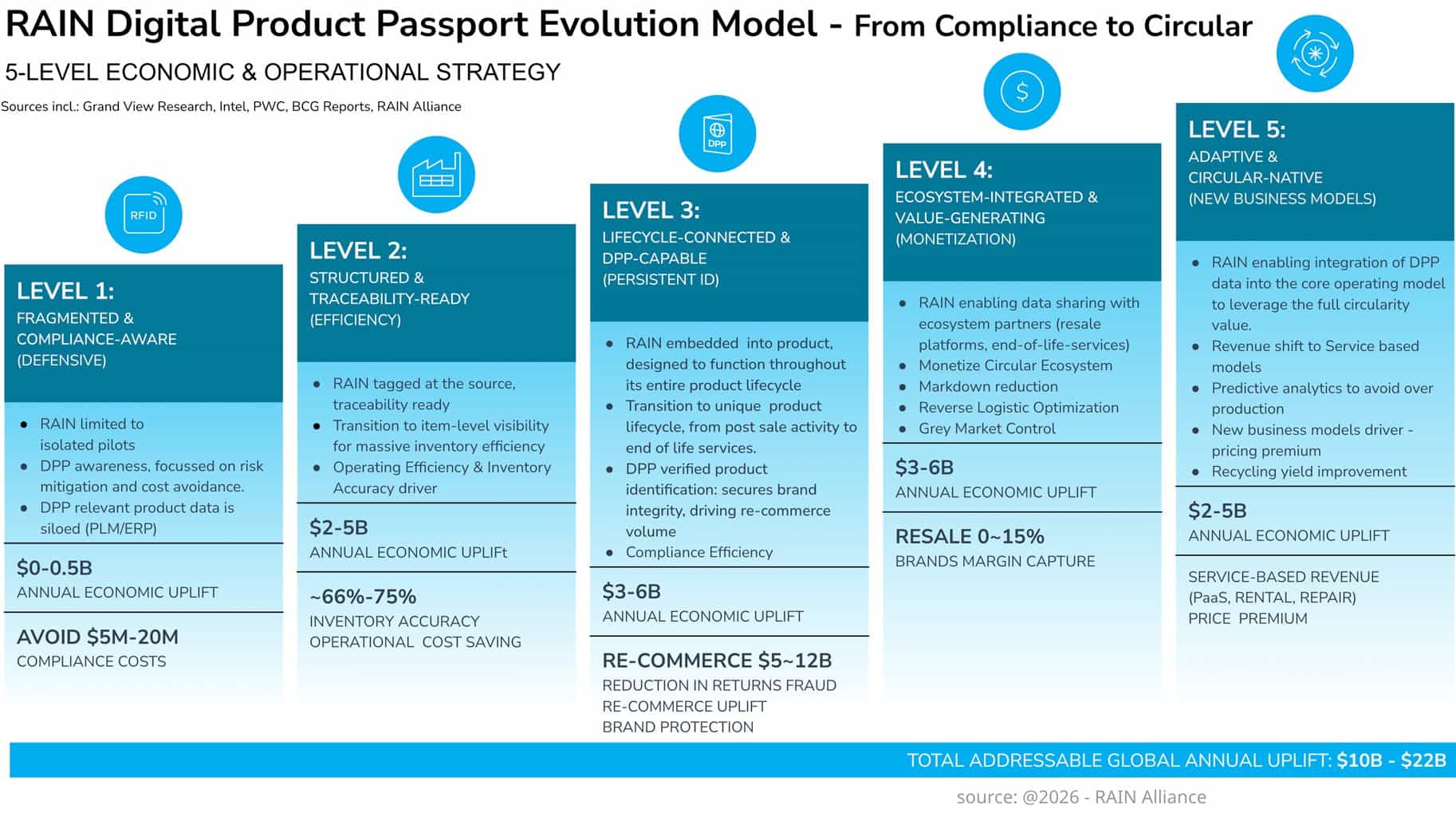
The 5-Stage DPP Evolution Model
Advancing from simple compliance to persistent digital identification transforms garments from one-time transactions into connected assets, unlocking $10 Billion to $22 Billion in total annual economic value across the global textile supply chain:
- Level 1: Fragmented & Compliance-Aware (0–0.5B Uplift): Siloed product data satisfies basic regulatory audits and avoids non-compliance penalties.
- Level 2: Structured & Traceability-Ready (2B–5B Uplift): Item-level RAIN RFID visibility boosts inventory accuracy from ~65% to 99%, driving a 1.5% to 5.5% sales uplift.
- Level 3: Lifecycle-Connected (3B–6B Uplift): Embedded tags remain active post-sale, combating return fraud and enabling entry into a $360 Billion recommerce market.
- Level 4: Ecosystem-Integrated (3B–6B Uplift): Serialized data sharing across partners unlocks 10% to 20% resale margins and optimizes reverse supply chains.
- Level 5: Adaptive & Circular-Native (2B–5B Uplift): Data powers rental, repair, and subscription models, maximizing closed-loop recycling yields.
Real-World Proof: Intelligent Sorting in Action
The business case for persistent digital identity is validated by live sorting and reverse logistics pilots:
- TEXAID (EU): Automated RFID sorting operates 3x faster than manual sorting (60 items/min vs. 22/min) with 99.9% identification accuracy.
- ReCircled (US): Automated data capture reduced scanning labor hours by 95.9% to 99.93% while capturing duty drawback data.
- ACS Clothing (UK): Garment check-in across resale, rental, and repair workflows achieved 90% time savings.
- CIRPASS-2 (EU): Avery Dennison is leading the flagship "Textile Loop" pilot, testing hybrid QR/RFID labels for end-to-end circularity.
Next Steps
Digital Product Passports should not be treated as a static reporting burden. Built on persistent, item-level identity, the DPP becomes a powerful engine for sustainable revenue growth, brand authentication, and circular material recovery.
Join "The DPP Exchange" LinkedIn Group to receive all the latest updates, insights and hot topics happening around DPPs.