
What happens when you put exceptional tools in the hands of exceptional people
By Nick Colisto - Apr 16, 2026



February 24, 2026

Head of Enterprise Sustainability
Share


Originally featured on LinkedIn
For as long as I’ve worked in and around global supply chains, food waste has been framed as a paradox of production. We’ve been told we need to grow more food to feed a growing population, that scarcity defines the challenge and that efficiency must start on the farm.
But the evidence shows that global food supplies have grown faster than population on every continent over the past six decades1, with food availability expanding even as the world added billions of people. In addition, primary crop output reached nearly 9.6 billion tons in 2022 — up more than 50% since 20002 — and global agricultural production value has increased dramatically in recent decades, with continued growth projected through 20343. These trends suggest that the challenge isn’t simply producing enough calories — it’s how we use what we already produce.
What if food waste isn’t a supply problem at all? What if it’s a logistics and connectivity problem hiding in plain sight?
We already produce enough. We just don’t move it well enough.
Globally, over one billion tons of food are wasted (discarded at the retail, food service and household levels) every year4. When combined with losses earlier in the value chain — such as during harvest, storage and transport — roughly one-third of all food produced never gets eaten5, estimated at over 2B tons annually6.
Food service and retail account for roughly 28% and 12%7, respectively, of food waste. Yet, these figures don’t tell the whole story. An additional 13% of food8 is lost earlier in the supply chain, before it even reaches restaurants, cafeterias, caterers and grocery stores. That means enormous value — labor, transport, energy and packaging — has already been invested before food is discarded at home. The takeaway is clear: While household waste remains important, an untapped opportunity lies in the supply chain itself. By improving visibility, logistics and connectivity from farm to fork, we can prevent waste before it occurs.
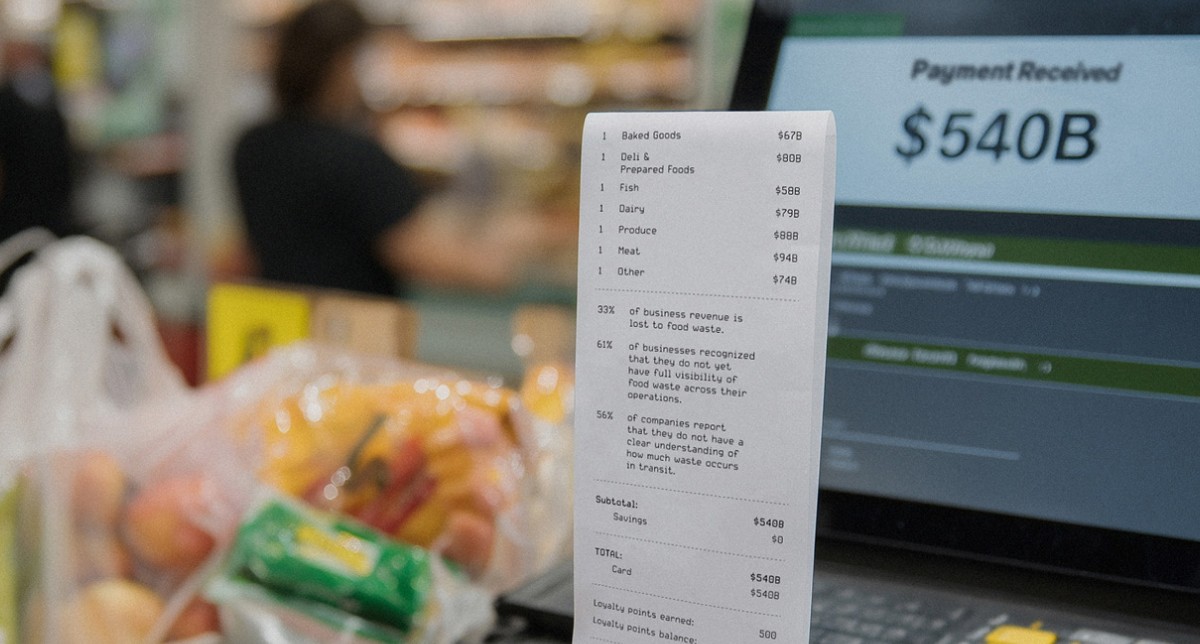
That insight was a driving force behind “Making the Invisible Visible,” research we conducted at Avery Dennison with the Centre for Economics and Business Research (Cebr). What we found surprised even seasoned supply-chain leaders:
When food is wasted at retail and during distribution, the true cost isn’t just the product itself — it’s the labor, energy, transport, refrigeration and handling associated with it. Measured this way, food waste represents a $540 billion annual value drain9 across the global food system.
That isn’t a supply issue. That’s a system efficiency issue.
Where the system breaks down
If we have enough food, why do we lose so much of it? Again and again, the answer points to blind spots. In our research, 61% of businesses told us they don’t have full visibility into where food waste occurs across their operations. Not because they aren’t trying — but because the system itself wasn’t designed for real-time insight across complex supply chains. That, coupled with the blind spots between partners across the supply chain, allows waste to fall between the cracks.
The gaps show up in very practical ways:
In transit, where temperature excursions or delays quietly compromise products long before anyone notices.
In forecasting, where supply and demand are mismatched because data is fragmented or delayed.
In collaboration, where partners across the value chain lack shared standards, shared data or shared incentives to act together.
Our report showed that over half of food waste occurs when oversight is weakest — during transport and handling. That’s not about growing more food. That’s about having the visibility to see what’s happening while food is moving.
Why this is a supply chain question — not just a sustainability one
Reframing food waste as a logistics and connectivity challenge changes who owns the solution. It shifts the conversation from “How do we produce more?” to “How do we connect what we already produce across the entire value chain?”
This reframing matters because logistics and connectivity across the supply chain is where speed, precision and coordination can live — and where data can make the biggest difference.
When we improve visibility, we don’t just reduce waste: We improve on-shelf availability. We reduce unnecessary markdowns. We cut emissions tied to wasted transport and refrigeration. And fundamentally, we protect margins and resources. This is what I often think of as the real opportunity to be a catalyst for change — solving for business performance and environmental impact at the same time.
From reactive to predictive supply chains
Today, many food systems are still fundamentally reactive. By the time waste shows up in a report, it’s already too late.
But imagine a different model. Products with digital identities that carry data across the supply chain. Real-time insight into temperature, location and handling conditions. Demand signals that help match supply to actual consumption, not historical averages. And fundamentally, data that can be shared — responsibly — across partners to reduce friction rather than create it. None of this requires a breakthrough invention. The technologies exist. What’s missing is systemic adoption and collaboration.
An invitation to the supply chain
Food waste is often described as inevitable — a cost of doing business. I don’t believe that’s true. I believe it’s a signal. A signal of system inefficiency. A signal that our systems were built for a different era — one without real-time data, without digital connectivity, without the pressures we face today.
If we take food waste seriously as a logistics challenge, not just a sustainability metric, we unlock a different kind of action — one led by supply-chain leaders, retailers, logistics providers and technology partners working together.
Reducing food waste by even 25% would be transformative — for businesses, for communities and for the climate. And it wouldn’t require producing a single additional calorie.
The food system doesn’t need more volume. It needs more visibility. The invisible is costing us more than we think. It’s time we start designing connected supply chains that can finally see it.
4https://sdg.iisd.org/news/one-fifth-of-all-food-wasted-while-783-million-go-hungry-unep-report/
5https://www.oecd.org/en/topics/policy-issues/food-systems/food-loss-and-waste.html
6https://www.worldwildlife.org/news/press-releases/over-1-billion-tonnes-more-food-being-wasted-than-previously-estimated-contributing-10-of-all-greenhouse-gas-emissions/#:~:text=Driven%20to%20Waste:%202.5%20Billion,Each%20Year%20%7C%20World%20Wildlife%20Fund
8https://wedocs.unep.org/rest/api/core/bitstreams/5a45a93c-93b9-4606-a9db-ed69d7158931/content
9Making the Invisible Visible: The $540B Grocery Bill https://avydn.co/4pFLQ6P
By Nick Colisto - Apr 16, 2026
By Pascale Wautelet - Mar 13, 2026
By Deon Stander - Jan 08, 2026